


×


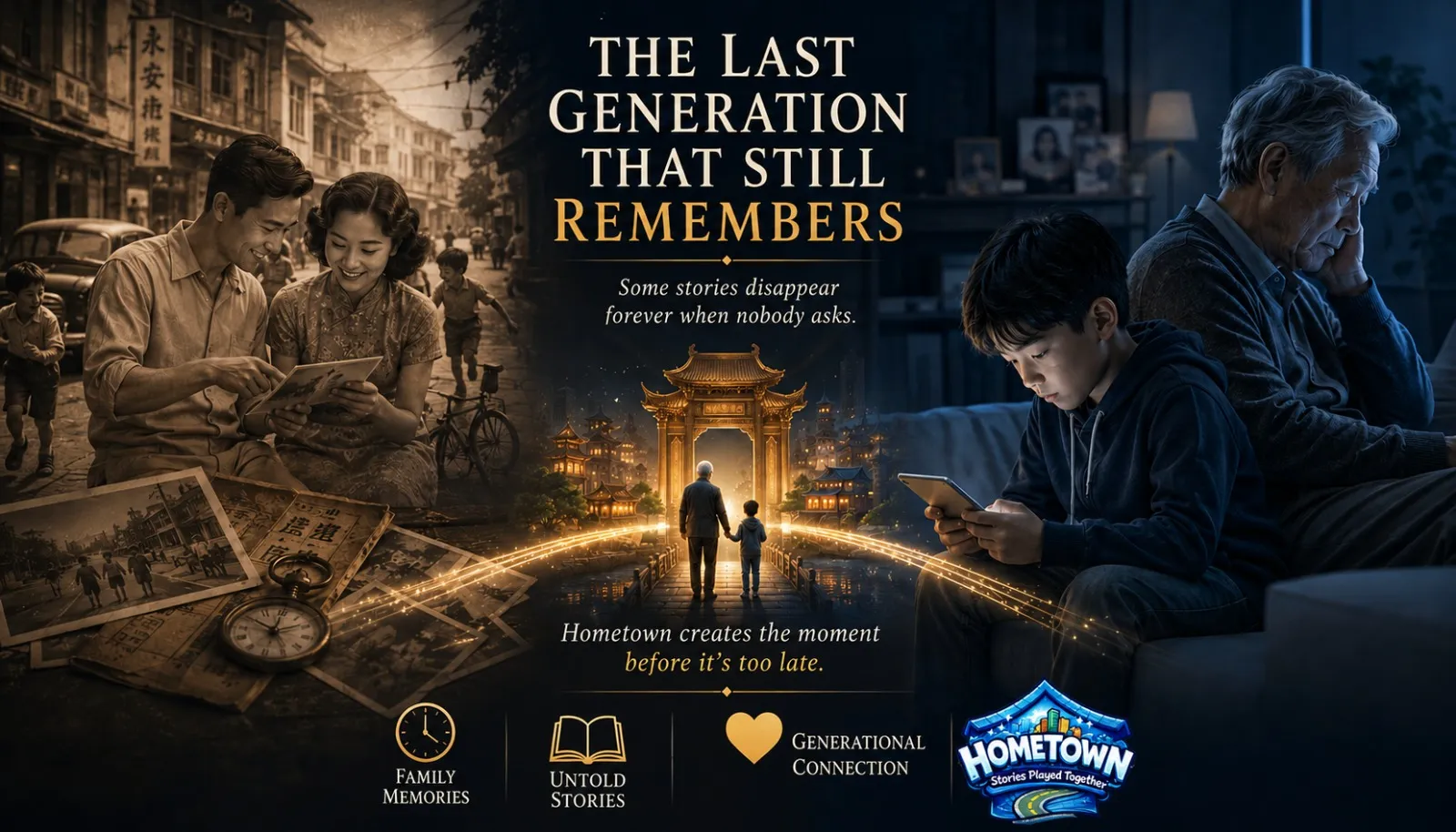

Technology promised to connect us. It did the opposite. Now a game called Hometown is asking the question that the entire industry forgot to ask: what if a screen could bring a family closer instead of pulling it apart?
Ask most people to name their grandparents' favorite childhood memory. Ask them where their grandfather played as a boy, what street their grandmother grew up on, how the family arrived in the city they now call home. Ask them what was sacrificed so they could have what they have.
Most people cannot answer.
Not because they did not love the people who carried those stories. But modern life has quietly dismantled the conditions under which such conversations happen naturally. The dinner table gave way to individual screens. The front porch gave way to separate rooms.
The stories did not disappear overnight. They dissolved, one unremarkable evening at a time, into the silence between people who love each other and have stopped knowing how to say so.
For most of human history, the transmission of family identity was a byproduct of proximity. Children absorbed who they were by being present with the people who knew. A grandfather did not schedule time to share his history. He shared it because the child was in the room, with nothing else demanding their attention.
That proximity is now rarer than at any previous point in recorded history. The average child today can learn about ancient civilizations within seconds. Yet research has found that many children reaching adulthood cannot name their grandparents' hometowns and have never been told the stories that would give them the deepest understanding of who they are.
Family stories are uniquely fragile. When a library burns, books can sometimes be replaced. When a hard drive fails, data can often be recovered. When a family story disappears, it is gone forever.
The loss carries consequences beyond nostalgia. Children who understand their family history develop stronger emotional resilience and a clearer sense of identity. Family narratives create continuity. They help young people see themselves as part of something larger than the present moment.
We are raising a generation with extraordinary access to the world’s knowledge and diminishing access to their own.
The technology industry has spent three decades asking one question: how do we capture more attention? Every product, every platform, every algorithm has been optimized toward a single metric, the length of time a person spends looking at a screen. This is not a conspiracy. It is a business model. And it has been extraordinarily successful.
It also produced something nobody designed, and nobody wanted: a world where the default state of family life is parallel solitude. Every household member absorbed in their own device, their own feed, their own reality that requires no one else and leaves no room for anyone else's story.
Families are not searching for more content. They are searching for more connections. The entertainment industry spent decades solving the wrong problem.
The question the industry forgot to ask is simpler and more important. Not how do we capture attention, but how do we create connection? Not how do we keep people on the platform, but how do we give people a reason to look up from the screen and look at the person beside them?
That question is now being asked. And the answer, when it comes from the right place, turns out to be one of the most powerful ideas in the history of family entertainment.
Hometown — Stories Played Together is not the game you are expecting. It does not ask you to compete. It does not reward you for spending money. It contains no advertisements, no timers, no leaderboards, and no mechanism by which one player defeats another. It works via Bluetooth, which means it requires no internet connection and, more significantly, it requires two people to be in the same physical space.
The premise is deceptively simple. Two players — a grandparent and grandchild, a parent and child, any two people who matter to each other, build a city together. One plans and guides. One explores and discovers. The city grows only when both of them build it. Neither can finish anything alone.
As the city grows, the world it reveals is drawn from real cultural heritage, real architecture, real places, and real history. The landmarks that appear as the city expands are not decorations. They are prompts. Each one is a reason for a grandparent to point at the screen and say something they have been carrying for years without an occasion to say it. Each one is a doorway.
Watch the video and pay attention not to the game, but to the faces. A family in a sun-drenched garden, leaning over old photographs. An elderly hand holding a postcard of a town square that no longer exists. And at the end, a mother watching a screen with tears running quietly down her face while her child sits beside her.
Those tears are not a marketing decision. They are a recognition. The recognition that something has been missing from family life for a long time, and that someone has finally built a doorway back to it.
It would be easy to describe Hometown as a clever product. A well-designed piece of family entertainment that happens to emphasize cooperation over competition. That description is accurate and entirely insufficient.
What Hometown represents is a philosophical position that the entertainment industry has resisted for decades. Human relationships deserve to be at the center of the experience. Not as a feature. As the purpose.
The most important innovation in family entertainment is not technological. It is philosophical. It is the recognition that the relationship is the product.
Around the world, societies are confronting the consequences of a generation raised in digital isolation. Loneliness affects both the very young and the very old. Grandparents who have never been closer in calendar terms to grandchildren they barely know. Children are more connected to strangers online than to the people whose blood runs in their veins.
Against this backdrop, a game that requires two people to be in the same room is not a small thing. It is a counter-argument. A quiet, careful, beautifully designed counter-argument to the direction the world has been moving for thirty years.
There is an urgency that families feel every day without always being able to name it. The stories that only get told once are not waiting patiently. They are fading with each passing year, slipping away in quiet moments across living rooms everywhere, where someone who remembers a place that no longer exists is sitting beside someone who has never thought to ask about it.
A grandfather carries a version of the family's history that exists nowhere else. Not in any archive. Not in any document. It lives in him, in the specific weight of a particular afternoon sixty years ago, in the name of a street that was demolished before his grandchildren were born. When he goes, it goes.
"One day, every family story becomes history. The only question is whether we preserve those stories while the people who carry them are still here to tell them. "
Hometown was built around a simple truth: time with the people we love is limited. The chance to hear their stories, laugh at their memories, and understand the world they came from does not stay open forever. Every part of the experience was designed with that in mind. The goal was never just to create a game. It was to create a reason for families to sit together, talk a little longer, ask one more question, and hold on to the stories that might otherwise be lost.
The game is coming this summer. The window is open right now. And in families across the world, there are stories still waiting for the right moment. A quiet evening. A simple conversation. Nothing planned and nothing extraordinary. Just a moment when someone finally asks a question they have never asked before, and someone else finally shares a memory they have carried in their heart for years. Those are the moments that become treasures long after the conversation is over.
This article is also available on Open PR: The Last Generation That Still Remembers
Download Hometown Free — iOS & Android
© 2026 Hometown Games • info@hometowngames.app • 1-323-237-9182
Not simply that games can entertain. But they can help families remember, share, and create stories worth carrying into the future

