


×


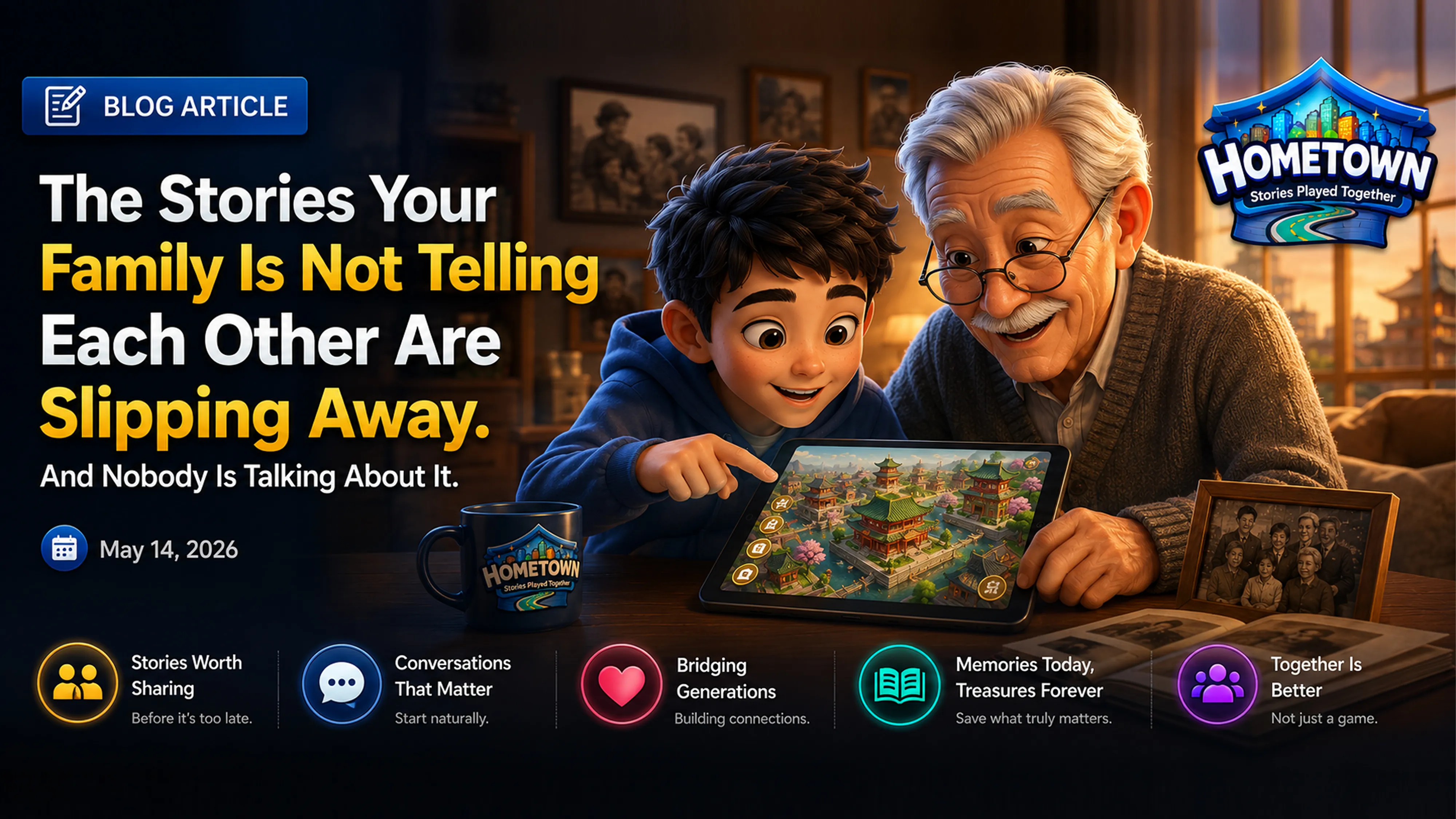

There is one window left. It is closing. And a game called Hometown was built to keep it open long enough for the conversation to finally begin.
Somewhere in your family right now, there is a story that has never been told out loud. Not because the person who carries it does not want to tell it. Not because the people who should hear it do not want to listen. But because the moment has never quite arrived. Because dinner ended before it began. Because the phone lit up. Because the evening dissolved in the particular way that evenings dissolve in 2026 quietly, without drama, with everyone still in the same room and no one anywhere near each other.
That story is still there. It is waiting. But waiting has a deadline that nobody likes to name.
A grandfather carries memories that will leave the earth with him. A grandmother holds a version of the family’s history that exists nowhere else not in any archive, not in any document, not in any cloud storage service. It lives in her, in the precise weight of a particular afternoon fifty years ago, in the way a street smelled in winter, in the name of a place that no longer exists on any current map. When she goes, it goes. And every day that passes without the conversation being started is a day closer to the moment when it cannot be.
We know this. All of us know this. We have known it for years. And yet the conversation has not started. Because knowing something and finding the moment to act on it are not the same thing. Because families are busy and evenings are short and everyone has a screen and the screen is always easier than the silence.
The stories that only get told once are disappearing right now — not in distant libraries or crumbling archives, but in the living rooms and kitchens of ordinary families everywhere.
This is not a small problem. This is a civilisational one. The transmission of culture, of identity, of the particular knowledge of who a family is and where it comes from — this has always happened in person, in the same room, across the table. It has always happened in the ordinary moments. In the cooking of a meal. In the looking at an old photograph. In the pointing at a spot on a globe and the question that follows: what is there, and have we ever been?
Screens did not pull your family apart. Individual screens did. And nobody noticed the difference until it was almost too late.
There is a specific kind of loneliness that does not have a name yet. It is the loneliness of being in a room full of people you love and feeling, despite everything, unreachable. It is the loneliness of a grandmother who watches her grandchildren on their phones and does not know how to begin. It is the loneliness of a child who would ask the question who are we, where do we come from, why does it matter but has never been given a doorway to walk through.
Technology promised to solve this. For thirty years, we were told that connection was one device away. We got the devices. We got more of them. We got faster ones, thinner ones, ones that fit in a pocket and respond to a voice and know what we want before we ask for it. And the gap between a grandparent and a grandchild, measured not in miles but in shared understanding, has never been wider.
The problem was never that we lacked technology. The problem was that every technology we built was designed to be used alone. One person. One screen. One perfectly curated stream of information that had nothing to do with the person sitting three feet away. We built tools for individual consumption in an era that desperately needed tools for shared creation.
Every technology we built was designed to be used alone. We needed something that could only be used together.
The result is a generation of grandparents who have never been more isolated from their grandchildren. A generation of children who have never been closer, in calendar terms, to people who carry stories they will spend the rest of their lives wishing they had heard. And a silence in the living room that everyone can feel and nobody knows how to break.
A door between a grandparent who remembers everything and a grandchild who has not yet heard any of it.
Hometown is a two-player city-building game. That description is accurate the way calling a letter a collection of words is accurate. Technically true. Entirely insufficient.
What Hometown actually is, at its core, is a shared space. A world that two people build together one planning, one exploring that neither of them can build alone. It runs on Bluetooth, which means no internet, no connection to the outside world, no intrusion from anywhere else. It contains no advertisements. No timers. No competition. No mechanism by which one player can win and the other can lose. It is, by design, the opposite of every other game on the market.
The world being built inside Hometown is drawn from Chinese cultural heritage — gateways and pavilions and architecture from real places and real history. As the city grows, landmarks unlock. Each one is a prompt. Each one is a reason for a grandparent to say the sentence they have been carrying for years without the right occasion to release it. Each one is a doorway. The game does not force anyone through it. It simply leaves it open and waits.
This is the idea that changes everything about how we think about what a game can be for. Not entertainment. Not distraction. Not the way you fill the thirty minutes before sleep. But the reason two people who love each other end up having the conversation they have been circling for ten years, in the middle of a Tuesday evening, over a city they built together on a tablet screen.
The grandfather watching television right now. The grandmother who has never been asked. The story that has one more evening to be told.
There is a grandfather somewhere tonight who knows the name of a street that no longer exists. He knows what it smelled like in winter. He knows the morning his family left and why. He is watching television. His grandchildren are on their phones. The evening is almost over.
This is not a tragedy. It is an ordinary evening. It is happening in millions of homes simultaneously. The tragedy is not tonight. The tragedy is the accumulation of tonight, and tomorrow night, and every night after, until the window closes and the story that was waiting to be told becomes the story that was never told.
The stories that survive are the ones that found a moment. Hometown is built to be that moment.
Hometown understands this with a clarity almost unheard of in games. It was not built to be the most exciting thing on the App Store. It was built to be the reason a grandfather and his granddaughter are still at the table at ten o’clock. It was built to be the reason the story gets told tonight instead of never.
The game is coming soon. The window is open now. And in families across the world, there are stories still waiting for exactly the right Tuesday evening an ordinary one, unplanned, unremarkable in every way except for the fact that it is the one where someone finally asks the question and someone finally answers it.
That evening is coming sooner than you think. Hometown is how it begins.
Stay updated! Read my blog on Blogger.
Download Hometown Free — iOS & Android
© 2026 Hometown Games • info@hometowngames.app • 1-323-237-9182

